

Phil Andrews, CEO of USA Fencing, explores how an Olympic sport that competes in convention centers rather than arenas can build premium fan experience and commercial revenue for the LA Olympics in 2028…
***
Fencing is an Olympic and Paralympic sport that lives in convention centers. A national tournament fills an exhibition hall with dozens of strips, thousands of athletes and almost no seats, because the room is built for competing, not for watching. That works for participants. It does very little for a fan.
In the summer of 2028 that must change. Olympic fencing, and then Paralympic fencing at the first Paralympic Games Los Angeles has ever hosted, will both be staged at the Convention Center in Downtown Los Angeles. It is one building for two Games, in front of a home audience that has mostly never watched either.
We have two years to learn how to present both. So, we have started taking fencing out of the hall and into spaces it was never built for, a pier in New York and a city square among them. In September, our Creator Showdown ran for three days on Pier 17 in Lower Manhattan, in a layout built for 400 people, and it is on track to pass 100 million views. Here is what those spaces have taught us.
Five things the space has to do
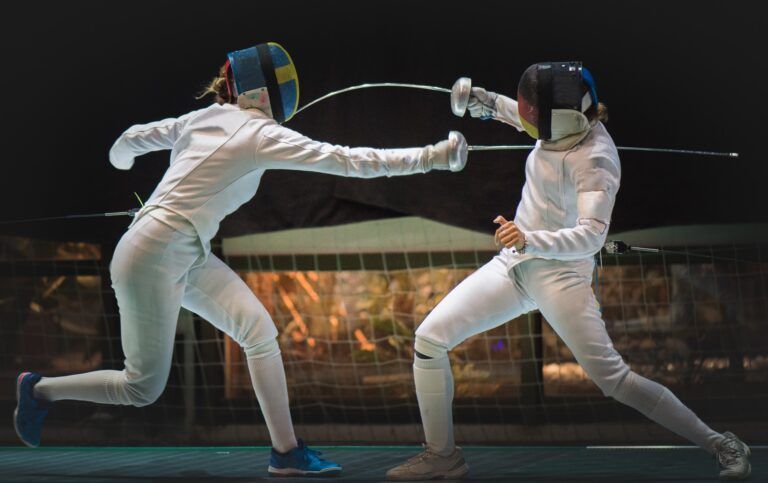
Sightlines. The Olympic strip is 14 meters long and less than two meters wide, and a touch lands in a fraction of a second. Every seat needs to be side-on and close, and a raised strip does more than a bigger room. Wheelchair fencing makes the point even more sharply. The chairs are fixed to a frame and the athletes do not travel, so all of the action happens in a space a few meters across. It rewards putting the audience almost within reach.
Lighting. Fencing is scored by lights. If the room is brighter than the scoring signals, the audience cannot tell who won the point. Indoors that means dropping the house lights and letting the strip glow. Outdoors it means thinking about the sun before anything else: where it sits in each session, which way the strip faces, and how large the signals must be to read from the back row.
Broadcast positions. Most people will watch on a phone. The main camera has to sit dead center and side-on, exactly where the best seats would go, so the camera plan comes before the seating plan. Athletes compete in masks, which means the faces come from the moments between points. The space needs somewhere for those moments to happen, and we now plan for vertical video as deliberately as for the main feed.
Crowd flow. A pier or a square is porous. People wander in halfway through with no idea of the rules, and every one of them is a potential fan. The venue has to explain the sport in ten seconds, with a host, clear signage and somewhere to pick up a blade and try.
Access. Design for the Paralympic athlete first. That means level routes from drop-off to the field of play, a raised strip reached by a ramp rather than steps, warm-up and equipment areas on the same floor, and accessible seating with a real view. A venue that works for a wheelchair fencer works better for everyone else too. Every fencer arrives pulling a long bag of equipment, and every family arrives with a stroller or a grandparent.
What LA28 changes
The temptation at the Convention Center will be to treat it as an exhibition hall with a grandstand. The lesson of the pier is to treat it as a theater: one strip, side-on seats, a dark room and cameras first. And the Paralympic competition deserves exactly the same staging as the Olympic one, in the same building, a few weeks later.
We have two years of rehearsals. Our Fence Across America tour visits 50 locations across 2027 and 2028. The New York–New Jersey Cup launches in June 2027 at American Dream, a retail and entertainment complex rather than an arena. Each one is a chance to test a format in a space that was never designed for us.
For venue operators, the opportunity runs the other way. Sports like ours do not need 20,000 seats. We need a flat floor, power, control of the light, step-free access and a reason for people to walk past. Plenty of buildings have exactly that, and so do plenty of piers, squares and concourses, on dates when nothing else is booked.
The next generation of Olympic and Paralympic fans will not find fencing by buying a ticket to an arena. They will find it because it was in their way.