
Xavier Vilajoana is a former Barcelona board director responsible for La Masia and Barcelona Femeni, and heads up the regional construction trade association in Catalonia. He explores why despite endless dates promised for its re-opening, Barca’s Nou Camp stadium remains a building site…
***
Camp Nou is not just concrete and seats, it’s a home. It’s the beating heart of Barcelona Football club and a symbol of Catalan pride. So why, as Barça continues through the new season, is our home still a construction site?
It was blindingly obvious the stadium is not ready during pre-season. Despite promises, the return to Camp Nou for the Joan Gamper March on the 10th August was never realistic. Many more promised dates for opening have come and gone since. And now, still without a clear timeline or honest communication from the club’s management, I, along with all other culers, feel deeply let down, disappointed by the lack of respect and, above all, the lack of truth.
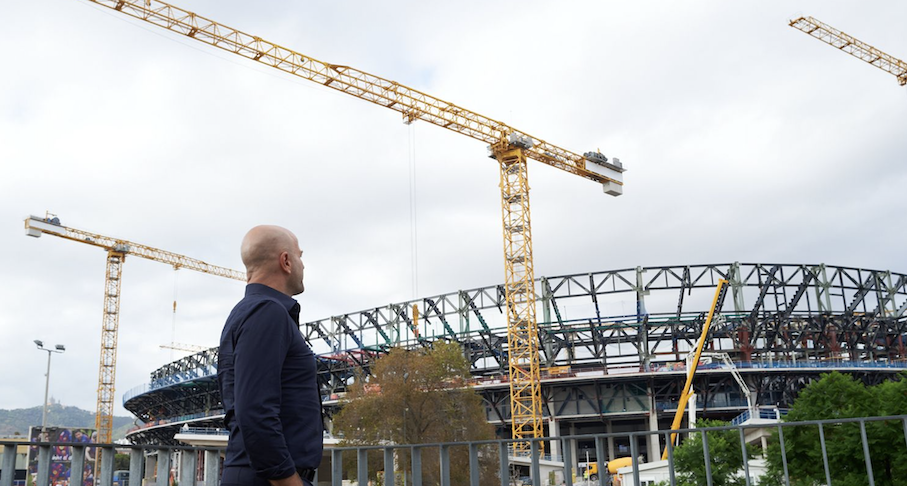
ABOVE: Xavier Vilajoana observing the Nou Camp in its current state
As someone who has played for the club, led its youth football section and also represents the construction sector across Catalonia and Spain, I speak with both affection and expertise when I say that this is unacceptable. In over two decades of working in the construction sector, I’ve built real projects, promoted sustainable housing and managed complex public-private projects. I know what it means to deliver. Unfortunately for Barça, this isn’t it.
The underlying problem is leadership, or rather, the lack thereof. The current management has not understood how the licensing process works on the part of the local authorities. According to current regulations, any application for a ‘partial’ first occupancy licence must have been ‘planned’ – a word that does not exist in the current management of the Board of Directors – and specified in the initial building permit application itself. Was this done?
Furthermore, once part of the stadium is certified for use and officially handed over to the club by the construction company, it enters a warranty and maintenance phase. This means that no further major works can be carried out in the areas handed over without infringing the regulations, unless the relevant permission is requested. Does anyone really think that no further work would need to be carried out on the “completed” first and second tiers? In short, once an area of the stadium has been approved, it is no longer a construction site.
I am sure the club’s President will argue that delays in the project delivery stem from how the city authorisations work. The reality is that the current board promised a phased return without accounting for this legal reality – licensing prevents ongoing work above occupied areas. That mistake is now costing Barça dearly.
In addition to the mounting renovation costs, which are reported to currently sit at €1.45 billion, the club is spending €100 million a year to play at Estadi Lluis Companys. And now there are reports that Barça may have to leave our stadium again in 2026/27 when the new roof is installed. This is not a sustainable project. It’s financial carelessness. Barça’s identity, our future, is being tied to external financial institutions.
From the start, the construction timeline has been driven more by press headlines than by structural or legal feasibility. It looked good on paper, but it was never viable in reality. I have continuously raised concerns about the inconsistent timelines and lack of clarity. What we see now is exactly what I feared: delays, mounting costs, and still no accountability.
Despite conflicting reports this week, I am still of the view that all the signs are pointing to us not returning to Camp Nou until 2026. My plea to Barça’s board is to be just honest with us. We can handle the truth, what we can’t handle is being misled. Today, there is not a single fan that has clarity on when we will be back in the completed Camp Nou, how can that be right?
Following this summer of chaos, let’s remember what Barça is built on, not debt or vanity projects, but values. Our foundations are rooted in transparency, excellence and community. And I will always defend that model.