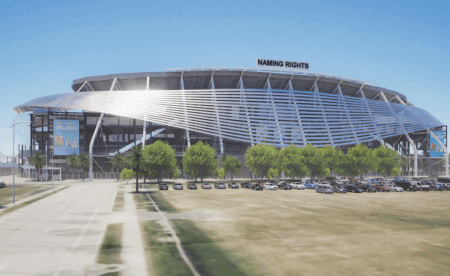


The spectacularly domed AT&T Stadium, temporarily renamed Dallas Stadium under FIFA’s clean-stadium naming policy, is hosting nine World Cup matches, the most of any single venue in the tournament. That distinction was not handed to it, but has taken years of planning and months of intensive construction.
To understand what has been done to AT&T Stadium for 2026, it helps first to understand what it already was. Opened in 2009 at a final cost of $1.15 billion – nearly double the original $650 million estimate – the stadium was designed by HKS Architects under lead architect Bryan Trubey, whose stated ambition was that the building should feel less like a stadium and more like a civic structure.
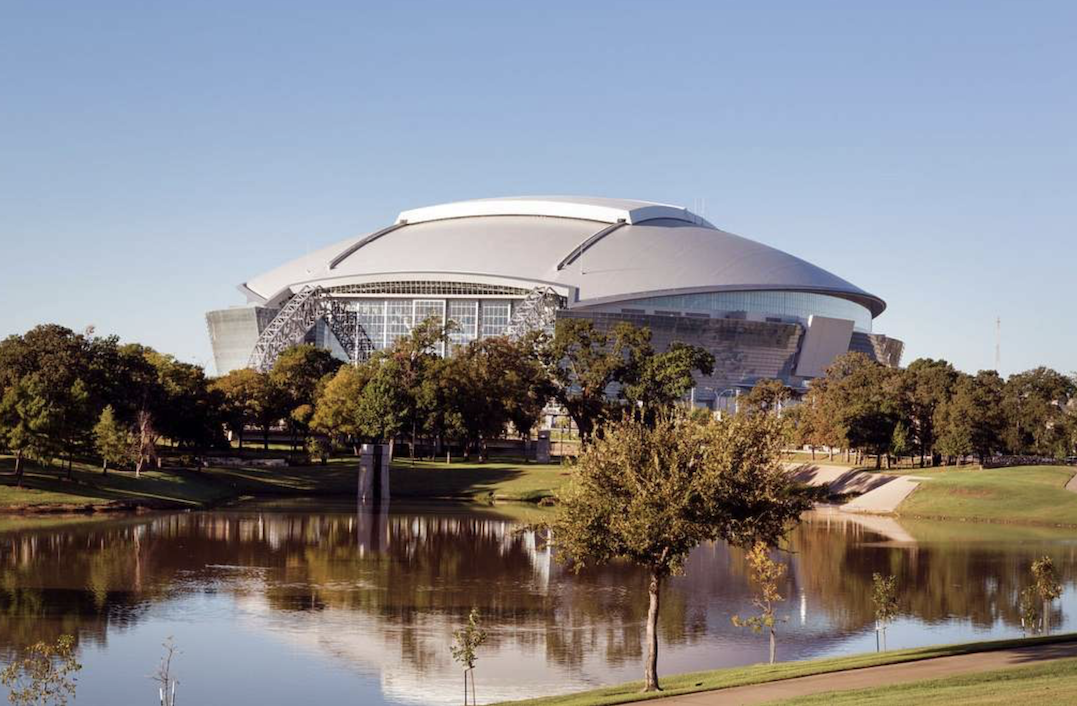
ABOVE: the AT&T Stadium is the largest domed venue in the world
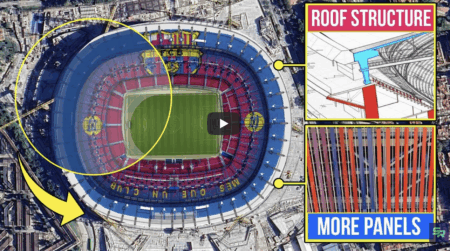
The retractable roof membrane rests on two steel arches each standing 300 feet tall, spanning the full length of the dome, among the longest single-span arches in the world. At each end zone, glass doors measuring 180 feet wide by 120 feet high can open or close in approximately 18 minutes, creating an indoor-outdoor environment that is, by any measure, extraordinary.
The stadium is widely described as the largest domed stadium in the world by enclosed volume, and the world’s largest air-conditioned room, a claim that carries real operational significance when July temperatures in North Texas routinely push towards 40°C.
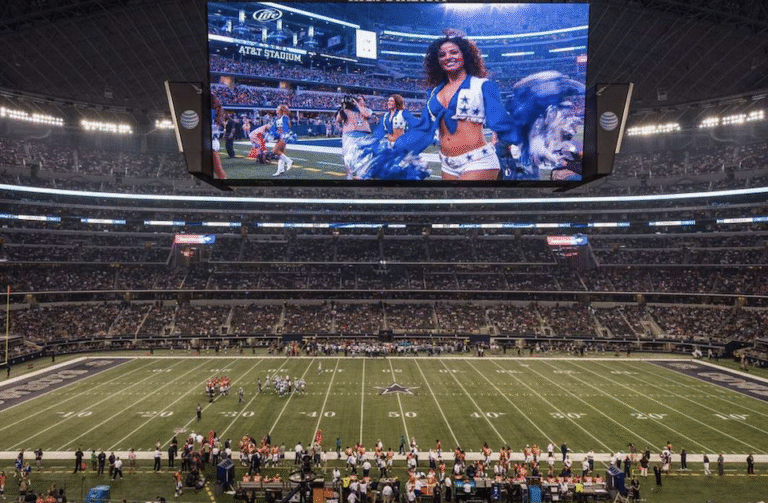
Its center-hung video boards are among the top 100 largest high-definition screens in the world, suspended 90 feet above the field and capable of being seen from virtually every one of the stadium’s 80,000 fixed seats.
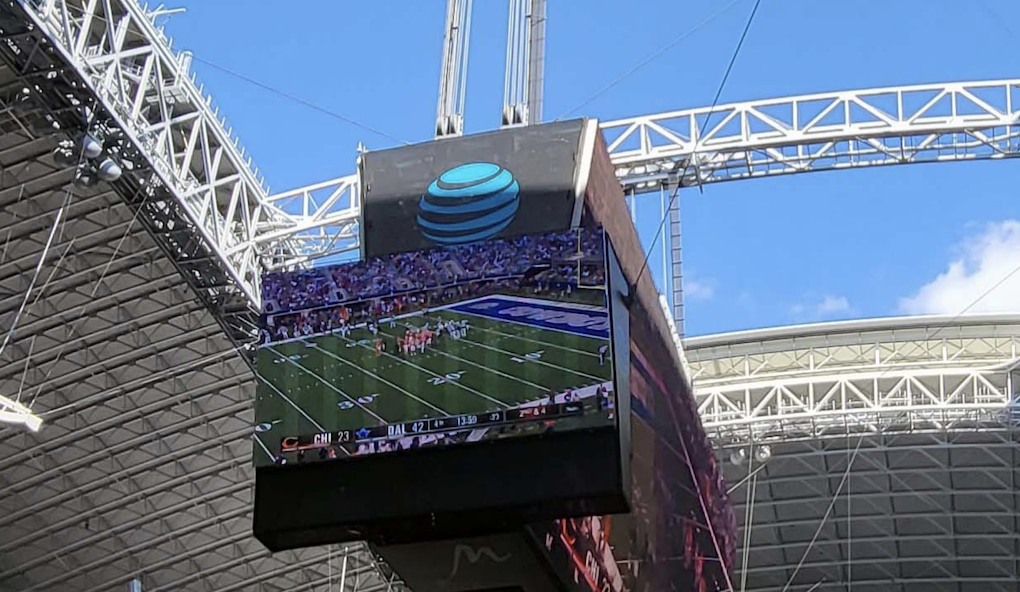
ABOVE: the center-hung video boards can be viewed from any of the 80,000 fixed seats
The art collection alone, including works by Anish Kapoor, Olafur Eliasson, and Teresita Fernández, is valued at more than $40 million, with guided tours available on non-event days. This is a building that already pushed hard against the boundaries of what a stadium is supposed to be.
Ground-up transformation
FIFA’s requirements, however, push harder still – and meeting them at AT&T Stadium involved solving a problem that has no simple solution: how do you grow natural grass inside one of the world’s great enclosed arenas?
Installation began approximately two months before the tournament, with a crew of around 50 people. The process started with irrigation and ventilation systems, followed by roughly ten inches of sand to support the natural grass surface. Above that, the pitch sits 4.5 feet above AT&T Stadium’s NFL field, supported by layers of gravel, drainage pipes, sand, and sod.
The playing surface itself is a blend chosen with player welfare in mind. The Kentucky bluegrass and ryegrass mix was grown in Colorado before being transported roughly 800 miles to North Texas by specialist contractor Precision Turf.
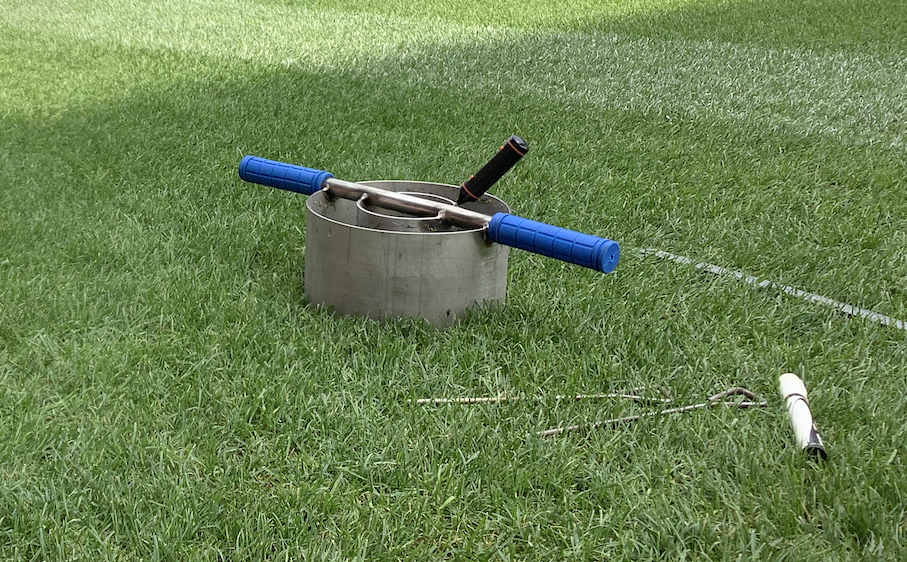
ABOVE: the pitch sits 4.5 feet above the NFL field supported by layers of gravel, drainage pipes, sand and sod
Beneath the surface lies a complex system designed to maintain the field in optimum condition throughout the five weeks of competition.
But the most striking element of the transformation – the detail that signals just how far the engineering challenge extends – involves light. Because the stadium’s retractable roof does not admit sufficient sunlight for healthy grass growth, crews installed large grow lights suspended from the ceiling, a setup that FIFA’s head of pitch infrastructure, Ewen Hodge, said had never previously been attempted at this scale. Photographs of the installation – the vast dark interior of the dome bathed in an otherworldly pink glow – circulated widely in May, becoming an unlikely emblem of the lengths to which the tournament’s host venues have gone. The field has also been reinforced with nylon fibres stitched into the grass using specialist machinery designed to improve durability across the full run of matches.
To accommodate the wider FIFA-regulation pitch (105 metres by 68 metres, compared with the narrower NFL field) lower-level suites and seats had to be removed to allow players sufficient space for corner kicks and team benches. Additional high-capacity, custom-built field-level suites were added to ensure compliance with FIFA regulations. The capacity configured for World Cup use is approximately 94,000.
The total transformation has consumed roughly 45,000 man-hours and involved hauling in 15,000 tonnes of materials, according to stadium general manager Tod Martin. That figure alone puts the scale of the operation in sharp relief.
Deep research
The grass installation at Dallas Stadium did not emerge from improvisation. FIFA has described the wider programme as needing six to seven years of research to implement, and the work behind it is embedded in a formal academic partnership. FIFA sponsored a five-year sports turf research initiative with the University of Tennessee and Michigan State University, focused on developing grass strains suited to the specific demands of enclosed and semi-enclosed stadium environments. The Kentucky bluegrass and ryegrass blend now covering the Dallas Stadium pitch is, in part, a product of that research; engineered for consistency, durability, and adaptability across the range of climates represented by the tournament’s 16 host venues.
The same sod-on-plastic technique first trialled at the Pontiac Silverdome for the 1994 World Cup has been refined and improved in the three decades since. Dallas Stadium in 2026 represents the furthest that technique has yet been pushed, not just in scale, but in environmental complexity. Growing grass inside a sealed dome, under artificial light, in a Texas summer, for the highest-profile sporting event on earth, is a different proposition entirely from anything that came before.
A record that matters
Venue manager Ian Craig has noted the scale of what Arlington is taking on: “This is the most of any venue here at the World Cup.” Nine matches across five weeks, group stage through knockout rounds, represents a logistical undertaking that will test not just the grass but everything built around it: the catering, the transport infrastructure, the security operation, the maintenance windows between fixtures.
Concession offerings have been redesigned to reflect the global audience, with football-inspired additions sitting alongside the stadium’s traditional offer. The signage, scoreboards, and banners throughout the building have been overhauled to shift the venue’s identity from NFL franchise to international sporting stage. For the duration of the tournament it is, in name and in character, Dallas Stadium.
Whether the grass holds up across all nine matches -under heavy use, in enclosed summer conditions, maintained by grow lights between fixtures – will be the true test of everything the past several years of research and months of preparation have been building towards. Early signs were positive: after the Netherlands and Japan opened the venue’s World Cup programme with a 2-2 draw, player reviews of the surface were encouraging, suggesting the turf scientists and the installation crews have, so far, got their sums right.
In a building full of records – biggest dome, biggest screen, biggest art budget – perhaps the most meaningful one this summer is the simplest: nine matches. No venue in the tournament is doing more.