


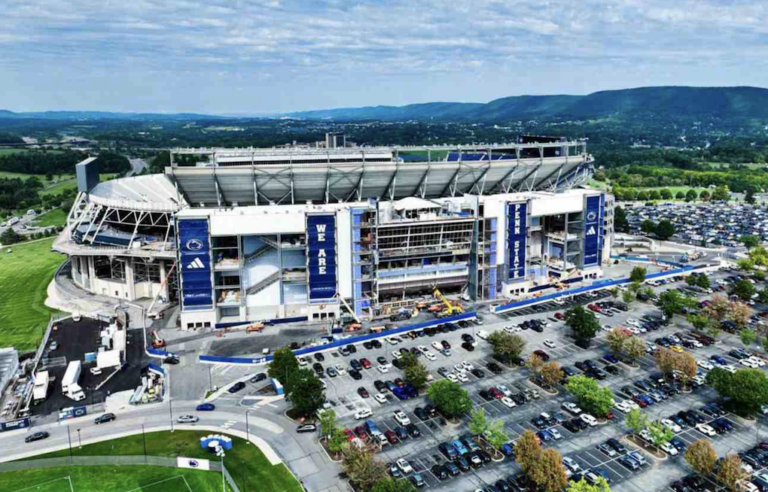
Beaver Stadium, one of the largest sporting venues in the world, is about to begin the last stage of its $700m transformation. Once the Penn State Nittany Lions have played their final college football home game of the 2026 season against Rutgers, work will start on demolishing the lower section of the west stand, which will then be rebuilt to modern standards.
The work marks the third and final phase of a three-year renovation programme. Completion is targeted for the start of the 2027 season, with capacity set to remain above 106,000. Penn State athletic director Pat Kraft confirmed over the summer that the project is on schedule and on budget.
Among the most notable changes is the removal of the stadium’s traditional bench seating in favour of individual seats with backrests, giving fans an extra 10 inches of depth compared with the current arrangement.
The west side redevelopment will also add around 85,000 sq ft (7,897 sq m) of new concourse and circulation space, including additional toilets, beverage stations and standing areas. A key element is a main concourse that will link the different sections of the venue and run the full circumference of the stadium, creating a continuous circulation loop for the first time.
Hospitality is central to the project, with two large premium clubs planned for the west stand. The Marzano Club will extend to around 50,000 sq ft (4,645 sq m) and include several bars and an outdoor terrace, while the Schuyler Family Club will cover around 20,000 sq ft (1,858 sq m). Both will feature lounges, seating, video screens and food and beverage offerings.
Penn State is making approximately 4,500 seats with club access available, priced from US$4,900 per seat alongside a one-off contribution of US$10,000. The pricing structure has, however, drawn criticism from some long-standing season-ticket holders.