

Across Europe, that role is coming into sharper focus. Many cities are facing a common set of challenges: ageing stadium stock, rising expectations from fans and communities, increasing pressure on public investment, and a need to demonstrate tangible social value. In Germany, where much of the current stadium portfolio’s most recent upgrades date back to the 2006 World Cup, this moment of renewal presents a clear opportunity. Two decades on, as football fans around the world are enjoying the 2026 World Cup, we have been taking a closer look at how the sports stadium market is changing.
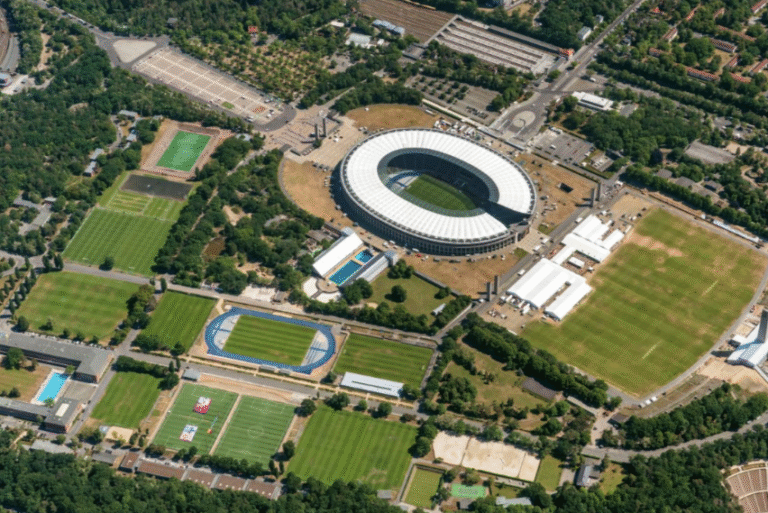
Cities such as Berlin, where the Olympiastadion remains a historic but ageing asset, and Friedrich‑Ludwig‑Jahn‑Sportpark, with its new and inclusive urban sports district, illustrate the varied challenges of modernisation and long-term viability. Meanwhile, projects in cities like Freiburg, with the recently opened Europa-Park Stadion, highlight how newer developments are embedding sustainability and community integration from the outset.

The question is no longer simply how to modernise stadiums. It is how to reimagine them as integrated parts of the city and extend their purpose – creating places that work harder, for more people, every day of the year and would be an urban destination; a “third place” for the community and city.
Over the past two decades, international stadium projects have helped redefine what is possible. From the Emirates Stadium to Tottenham Hotspur Stadium and Everton’s new Hill Dickinson Stadium, the model has shifted from standalone venues to drivers of district-scale transformation. For example, the Tottenham Hotspur Stadium forms part of a €1.4 billion (£1.2 billion) regeneration programme and has contributed €398m (£344m) in GVA and supported more than 3,700 jobs in its surrounding area³. The stadium is not simply a destination, but a focal point for investment, employment and community activity.
Michael Salvo, Buro Happold’s director of European sport and entertainment, observes that this shift reflects a wider market evolution rather than a series of isolated projects: “There’s a growing recognition that a stadium is not simply a building project. It can be the catalyst for so much more,” he says. “The whole masterplan around a stadium is most impactful when it is mixed, fully-integrated and usable by the wider city and society. There needs to be a real place-making element to a successful stadium project. Critically, this applies as much to the evolution of existing stadia as it does to new developments, where the opportunity often lies in unlocking latent value through better integration and use.”
Rob Amphlett, who leads Buro Happold’s UK Sport and Entertainment sector, and led the Tottenham project for Buro Happold, says stadium developments in the UK are rarely now standalone projects and Buro Happold’s engineering experts are key to realising their true value. “Bringing in the right expertise at an early stage is key to realising the full potential for the community, club and wider economy,” he says.
He makes the point that stadiums are more than buildings – they’re symbols of identity. “Clubs are born out of their communities,” Amphlett says, “and increasingly, their brand is rooted in that community.”
In Liverpool, Everton FC’s new home at Bramley-Moore Dock, the Hill Dickinson Stadium, is reshaping the waterfront to the north of the city centre. “It’s more than just a stadium,” says Lloyd Baker, who led Buro Happold’s work on the project. “It’s a strategic move that unlocks regeneration across a whole tranche of the city.
“I believe the regeneration we’re now seeing along the northern waterfront in Liverpool, around Everton’s new stadium, has been speeded up by 20 years or more as a result of the stadium being delivered and acting as a real catalyst for investment.
What does this mean in the German context?
The answer is more nuanced, reflecting a different urban and political starting point. In Berlin, the conversation is not about a single solution, but about how multiple futures can be brought together. Within the Olympic Park, this includes both the potential for a new, football-specific stadium, as well as the reimagining of the existing Olympiastadion as a major civic and heritage asset. The strategic question, therefore, is how these opportunities can be aligned within a broader vision for the park as a whole – one that strengthens the role, relevance and long-term viability of both venues. This has wider significance in the context of Berlin’s potential Olympic bid, where the ability to demonstrate a coherent, future-facing vision for the park could unlock additional investment and reinforce its role as a nationally and internationally important destination.
That includes improving connectivity, activating surrounding spaces and exploring how the wider campus of sports, culture and education facilities could be brought together into a more coherent whole. Proposals such as Hertha Berlin’s potential new stadium add another dimension, raising the possibility of integrating modern infrastructure within an established civic landscape, rather than starting from scratch.
Berlin’s documented ambitions in its Urban Development Concept / Berlin Strategy 2030 focus on being a dynamic, innovative, green and socially inclusive city, with priorities such as housing delivery, economic growth, climate action, mobility and quality of life. By positioning the Olympic Park’s redevelopment as a hub for sport, culture and everyday civic life, Berlin can directly align stadium investment with its wider growth ambitions around innovation-led jobs, tourism, housing and sustainable urban regeneration.
At the same time, Berlin is also developing a very different model at Friedrich‑Ludwig‑Jahn‑Sportpark. Here, the ambition is explicitly about creating a new, inclusive urban sports district, combining a 20,000-seat stadium with community facilities, sports halls and public space. The contrast is instructive. Berlin is effectively telling two stories at once: how to extend the life and civic value of a historic stadium, and how to deliver a new generation of integrated, community-focused sports infrastructure in the heart of the city.
Hamburg points to a third approach. At Volksparkstadion, recent discussions has focused on maintaining international competitiveness through technical upgrades. But the longer-term opportunity lies in thinking beyond the stadium itself. With major development planned in the surrounding area, there is clear potential to evolve the wider Volkspark into a multi-use sports and leisure district. In this context, the stadium becomes less of a standalone venue and more of a catalyst within a broader piece of city-making. Hamburg can use stadium investment to advance its broader goals around sustainable growth, everyday recreation and inclusive economic opportunity set out in its urban development and climate strategies.
From destination to neighbourhood
Increasingly clubs are also seeing the economic and social value of investing in the 365-day activation of a stadium, rather than it standing unused between football matches.
Baker emphasises that this broader role needs to be understood from the outset: “You’ve got an asset that holds a lot of people and gives plenty of space to move around. Why would you only use that for one or maybe two days a week? We support clients to deliver stadiums that work all-year round and give the community more than the football. You’re not just designing a venue. You’re designing a piece of city infrastructure that has to work on match day and on every other day of the year.”
This distinction is critical. Evidence from across the world shows that for successful stadia, it is the integration with housing, commercial development, transport and public realm that enables true long-term impact. Greater London Authority’s report The Regeneration Game: Stadium-led regeneration in London, for example, reviews schemes like the Emirates Stadium, Wembley and the Etihad/City of Manchester Stadium and explicitly frames stadiums as catalysts when embedded in wider mixed-use and transport strategies.
The report underlines that stadiums generate the greatest value where they anchor wider, mixed‑use regeneration – and it backs this up with some hard numbers from recent London schemes. It highlights, for example, how Arsenal’s move from Highbury to Emirates Stadium almost tripled match‑day revenues (from roughly €42m [£37m] to more than €104m [£90m] a year), while the surrounding scheme delivered thousands of new homes, with a significant proportion designated as affordable housing. At the Olympic Park, it emphasises that the stadium is part of a 225 hectare transformation including new neighbourhoods such as East Village, extensive green and public spaces and major transport upgrades, rather than a standalone venue, even as it cautions that the broader economic “uplift” relative to other forms of development is still contested.