


On Sunday, MetLife Stadium will host the most-watched sporting event in history. With two years of preparation, over $100 million invested and the biggest metropolitan backdrop on the planet, this is what the World Cup final will look like…
***
This weekend, an estimated two billion people will watch the World Cup Final, the most-watched single sporting event on earth. MetLife Stadium – officially NY/NJ Stadium for the tournament’s duration – will hold 78,576 spectators for the final, the culmination of eight matches hosted across the competition.
No other venue at this World Cup carries that weight. The stadium that two NFL owners built with their own money in 2010 is about to host the most-watched single sporting event in history.
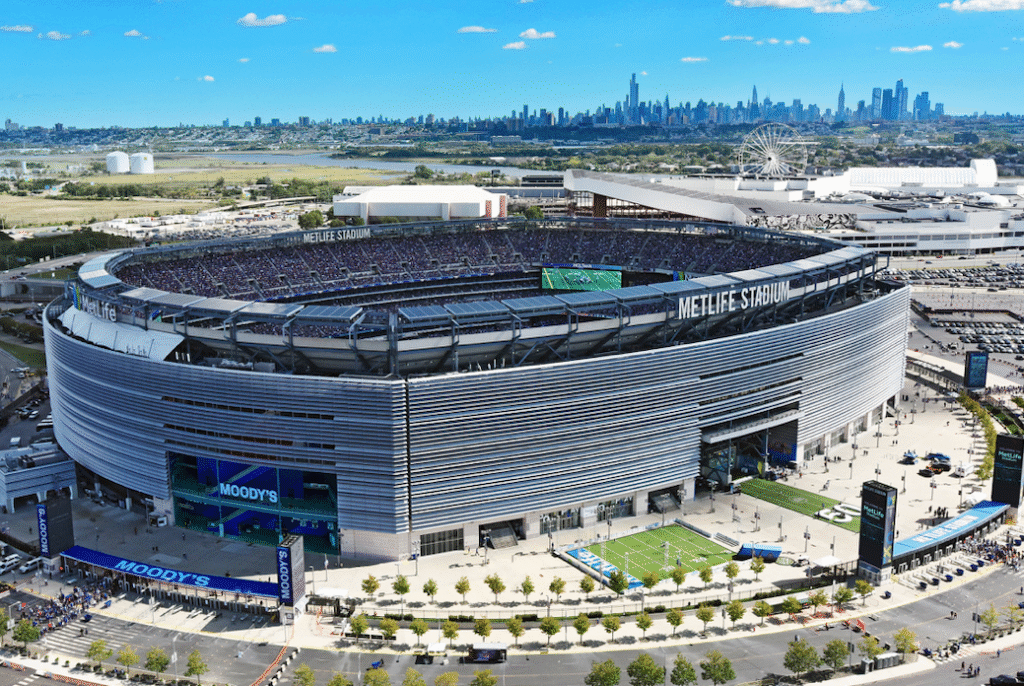
ABOVE: capacity at the final has been reduced by 4,000 to accommodate FIFA configurations
When EwingCole and Skanska arrived back at MetLife Stadium in January 2024, they were returning to a building they knew intimately. Both firms had delivered the original $1.6 billion construction in 2010 — at the time the most expensive stadium ever built, and the continuity was deliberate. The brief for the World Cup preparation was precise: transform the venue to FIFA specification, in two phases, without the Giants or Jets missing a single home game. That constraint shaped every decision.
The work was divided across two consecutive NFL off-seasons. Phase one ran from January to May 2024; phase two from January to May 2025. By completing each phase within the same five-month window, the project team kept the stadium fully operational throughout the NFL regular season and post-season in both years; a logistical achievement that tends to go unremarked but reflects a level of programming discipline that major venue operators will recognise.
Seating reconfiguration
The central structural challenge was geometry. FIFA requires a playing surface of 105 by 68 metres, wider and longer than an NFL field, along with mandatory perimeter clearances for players, officials, broadcast cameras and pitch-side advertising boards. At MetLife, the lower bowl corners sat too close to the field’s edge to accommodate those requirements without modification.
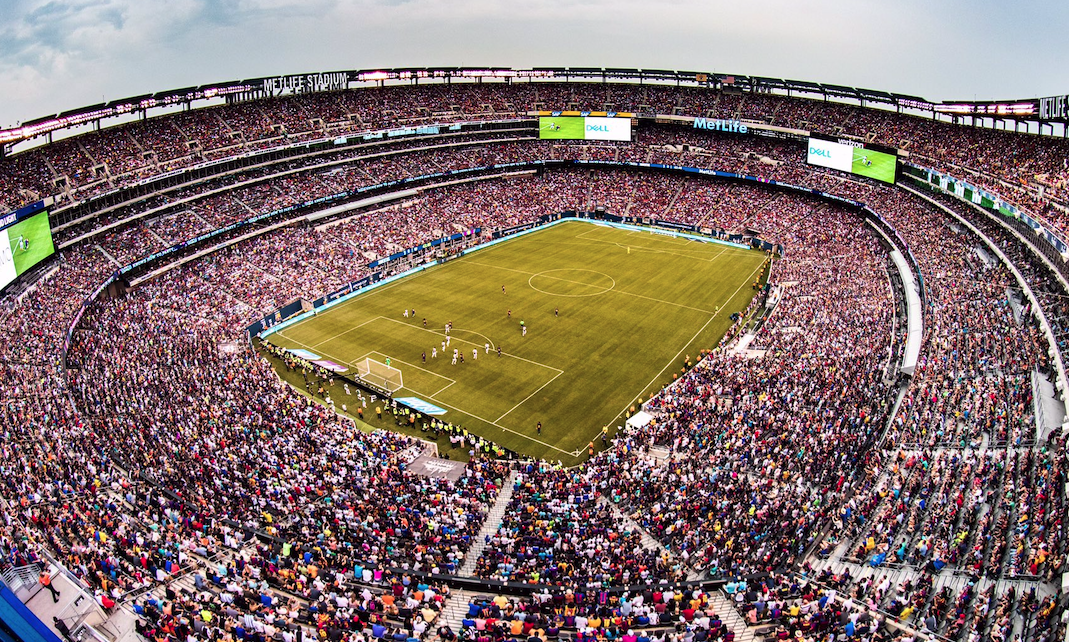
ABOVE: MetLife is the largest stadium in the NFL
Skanska’s solution was to demolish the four corners of existing precast concrete seating and replace them with a new modular steel composite system. The approach was chosen specifically because it is reversible: the modular sections can be dismantled after football and the original NFL configuration reinstated. In total, 1,740 permanent seats were replaced.
The mechanical, electrical, audiovisual and plumbing connections serving those sections were all renewed as part of the same scope, future-proofing the corners for further configuration changes beyond this tournament.
Broadcast and connectivity
MetLife’s broadcast infrastructure was rebuilt from scratch to handle a production the venue’s original designers could not have anticipated. The 2026 final is projected to draw an audience north of two billion — comfortably beyond any Super Bowl the stadium has previously hosted.
The electrical and fibre-optic network was upgraded throughout to support the volume of broadcast feeds, commentary positions, production compounds and data transmission that a global FIFA final demands. Wi-Fi 6 and cellular infrastructure were overhauled across the bowl, concourses and back-of-house areas, both for broadcast operations and for the 78,000 supporters who will be in the building on Sunday.
Concourses, accessibility and arrivals
Concourse capacity and flow were addressed across both phases. Wider circulation routes, refreshed food and beverage points and updated wayfinding were installed with an international audience in mind, one less familiar with the building’s layout than a regular NFL crowd.
Accessibility improvements were made throughout, covering new and upgraded facilities for supporters with mobility requirements. The exterior arrival zones were redesigned to handle the volume and dispersal patterns of a World Cup crowd, which arrives and departs differently, and over a longer period, than a domestic NFL matchday.
The pitch
MetLife ordinarily plays on artificial turf for NFL use. FIFA’s requirement for natural grass at all World Cup matches meant a full surface installation ahead of the tournament, one of the more operationally complex preparations at any of the NFL host venues.
The process was overseen with the knowledge that the final pitch would need to hold up through the tournament’s full run of matches at the stadium before being replaced. FIFA, evidently confident in the surface’s provenance, has been selling preserved pieces of the final pitch for $450 each, ordered now, shipped after the final whistle on Sunday.
The total cost of World Cup preparation at MetLife exceeded $100 million, on top of the stadium’s original $1.6 billion construction. The Giants and Jets ownership funded the majority, on the basis that the improvements — the modular seating system, the broadcast infrastructure, the connectivity upgrades — outlast the tournament and benefit both franchises for years to come. A further $100 million in federal transit investment was unlocked for the wider New York-New Jersey region as a direct consequence of hosting, a legacy that extends well beyond the stadium walls.
What the venue brings
MetLife is the largest stadium in the NFL, and at 78,576 for the World Cup configuration it is meaningfully bigger than any of the climate-controlled alternatives that might have hosted the final. That scale matters: the broadcast spectacle of a packed bowl on the sport’s biggest night is part of what makes a final feel like a final. The upgraded electrical and fibre-optic infrastructure installed for the tournament is designed to support exactly that; a global production at a scale and reach the sport has never previously achieved in this time zone.
The New York location also solves a problem that has plagued this World Cup for European audiences: the 3pm Eastern kick-off time puts the final at 8pm in London and 9pm in Western Europe; prime time for the billions watching at home, without a 2am alarm. For a tournament that has regularly tested the patience of European fans with overnight start times, the final delivers the audience the spectacle deserves.
The stadium’s football credentials are also stronger than its NFL identity suggests. MetLife hosted the Copa América Centenario final in 2016, Copa América group and semi-final matches in 2024, and last year staged the inaugural Club World Cup final – Chelsea’s 3-0 win over PSG – as a full-scale operational rehearsal for Sunday’s event. This is not a venue encountering major international football for the first time. It has been building towards this systematically.
The occasion
FIFA president Gianni Infantino put it plainly when the decision was announced: “Being in New York, which is such a cosmopolitan city, where you have between New York and New Jersey over 200 nationalities already there, celebrating and uniting the world, is really something unique.”
That sentiment will find its fullest expression on Sunday. The $100 million federal investment in regional transit infrastructure, triggered by the tournament, will serve New York and New Jersey commuters for decades beyond the final whistle.
The 2022 final between Argentina and France drew an estimated 1.5 billion viewers. With the 2026 final playing in an American time zone – accessible across the Americas, Europe and Africa without a middle-of-the-night alarm – projections for Sunday run north of two billion. MetLife Stadium, built without a penny of public money by two NFL franchises with the ambition to host the world, is about to deliver the biggest audience in football history.