

How FIFA transformed one of America’s most iconic venues into a World Cup showpiece; from burying a foot of asphalt to blacking out a thousand logos
***
When the first whistle blew at Atlanta Stadium on 15 June 2026, few of the 71,000 fans packed inside would have guessed that the ground beneath their feet had looked entirely different just months earlier. Gone was the FieldTurf CORE synthetic surface the Atlanta Falcons and Atlanta United had played on for years.
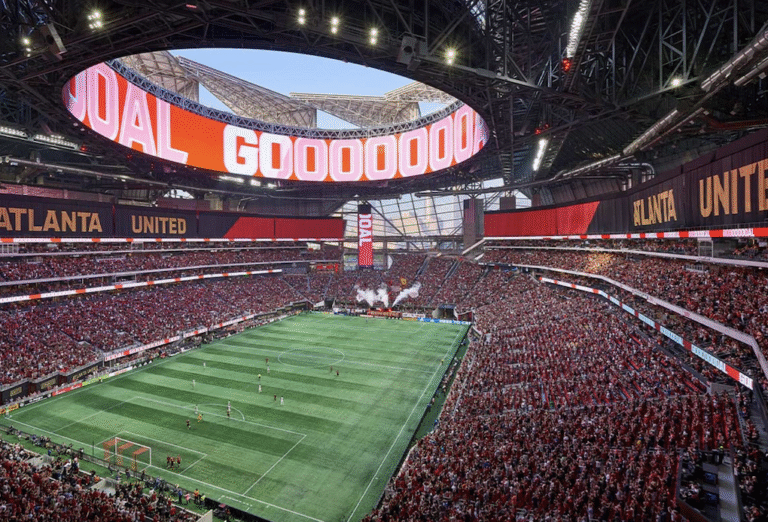
In its place: a dense, immaculate blend of Kentucky bluegrass and ryegrass, grown in Denver, Colorado, and tended under pink-hued grow lights in the middle of a climate-controlled dome. The transformation of Mercedes-Benz Stadium into Atlanta Stadium – FIFA’s preferred nomenclature for the tournament – was one of the most technically ambitious venue conversions of the 2026 World Cup.
The name goes first
Before a single sod was laid, FIFA’s clean-zone regulations began reshaping the stadium’s identity. The rules are unambiguous: all pre-existing commercial branding must be stripped, covered, or neutralised for the duration of the tournament, protecting the governing body’s own sponsorship portfolio from any suggestion of ambush marketing.
For Mercedes-Benz Stadium, the implications were sweeping. The venue holds a naming-rights deal with Mercedes-Benz worth a reported $324 million, signed in 2015 and running through 2042. For the World Cup, that agreement effectively steps aside.
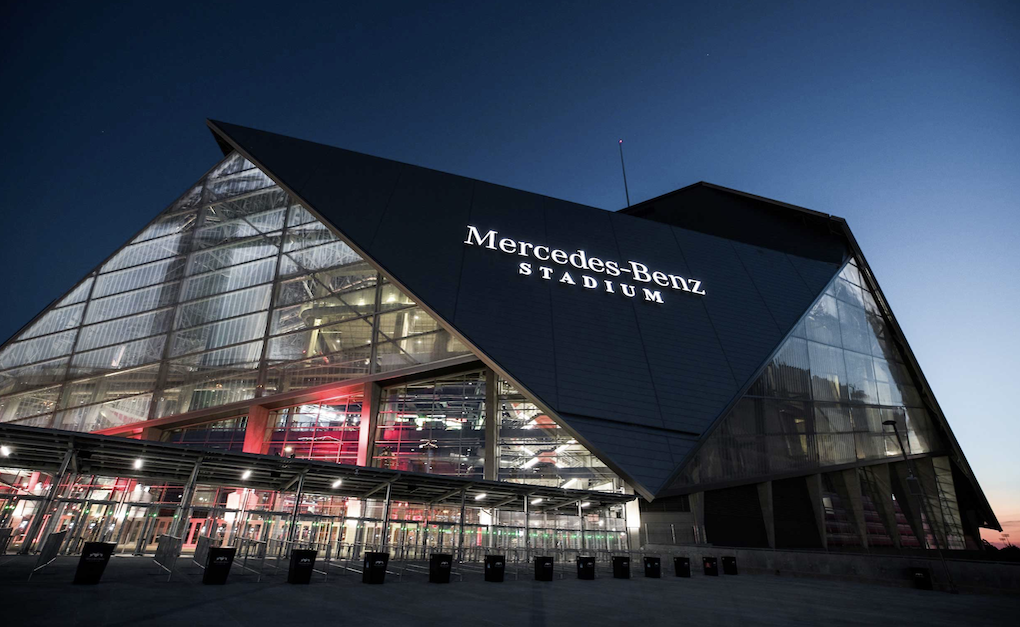
ABOVE: transformation of the Mercedes-Benz Stadium into Atlanta Stadium was one of the most technically ambitious venue conversions of the 2026 World Cup
The stadium officially became Atlanta Stadium, with crews draping FIFA World Cup 2026 banners over the prominent three-pointed star logos on the building’s exterior. Inside, Atlanta United and Atlanta Falcons branding gave way to tournament signage and World Cup memorabilia across concourses and scoreboards.
One element defied the clean-up operation entirely. The iconic Mercedes-Benz star is integrated into the centre of the stadium’s eight-panel retractable roof; a flexible, air-inflated ETFE structure that engineers advised could not safely accept vinyl wrapping or covering material. Any attempt to do so risked structural damage running into millions of dollars. After a year of negotiations between FIFA and the stadium’s operators, AMB Group, an exemption was agreed: the roof star would remain visible, though the roof itself was to stay closed for all matches, keeping it largely out of eye-line at pitch level. It is a quiet footnote to an otherwise near-total rebrand.
The same logic applied across the concourse. Coca-Cola branding was permitted to stay, as the drinks giant holds official FIFA partnership status. Delta, AT&T, and Mercedes logos were removed. More than 1,000 corporate marks in total were covered or taken down across the facility. Even the stadium’s Chick-fil-A concession stand was shuttered for the tournament, displaced by FIFA’s partnership with McDonald’s.
Tearing up the turf
The pitch conversion was the most structurally demanding element of the entire programme. Mercedes-Benz Stadium has long used synthetic turf for its dual NFL and MLS schedule — a practical compromise for a venue hosting two major-league tenants across very different sporting seasons. But FIFA mandates natural grass at all World Cup venues, and previous attempts at temporary grass solutions at the stadium had not passed muster.
During the 2024 Copa América, a temporary grass surface was laid over the existing synthetic base. Argentine goalkeeper Emiliano Martínez was among those who made their feelings known after his team’s opener in Atlanta. The surface was described as bumpy and inadequate – a stark warning to organisers that a more fundamental intervention would be needed for 2026.
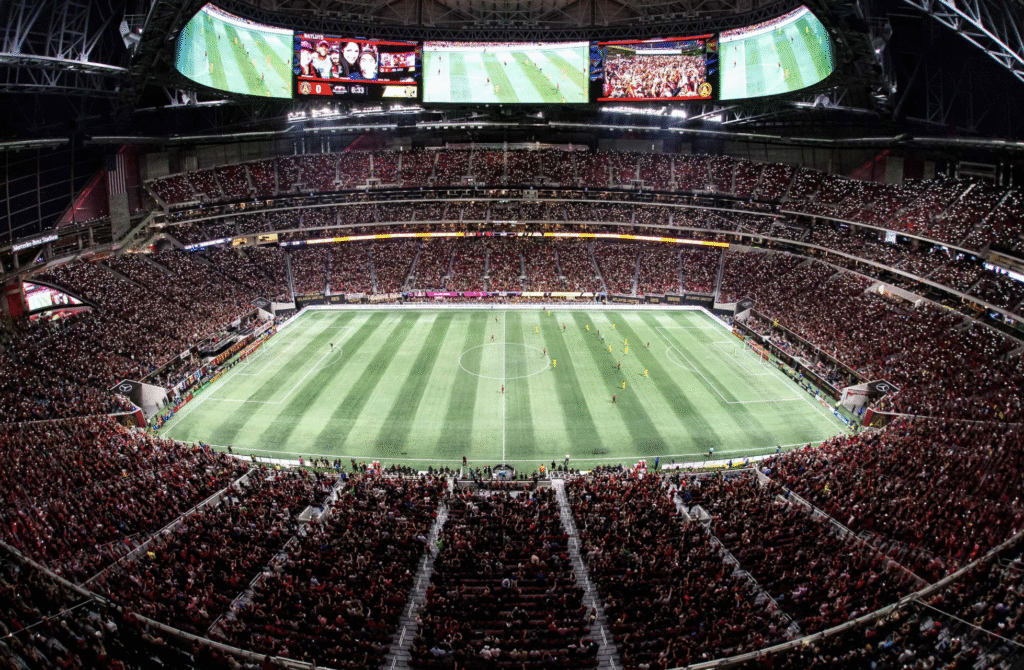
ABOVE: During the 2024 Copa América, the surface was described as bumpy and inadequate
What followed was a root-and-branch rebuild, quite literally. In early 2026, workers removed the synthetic turf installed at the beginning of 2024, then drilled out approximately a foot of asphalt from the stadium sub-base. In its place, they installed a SubAir drainage and moisture management system – the same technology used at Augusta National to control humidity and soil temperature during The Masters – alongside a 27-zone irrigation network capable of servicing every section of the pitch independently.
The grass itself – a ryegrass blend sourced from Denver – was laid using a modular tray system, producing a pitch measuring the FIFA-standard 105 metres by 68 metres. That is around 20 yards wider and five yards shorter than an NFL field, dimensions that the stadium had always been designed to accommodate. The SubAir system can evacuate excess moisture from the surface 36 times faster than natural drainage, with the equivalent of one hour’s rainfall cleared in under three minutes. Above the pitch, arrays of pink-spectrum high-intensity grow lights provide the photosynthetic energy the grass cannot draw from natural sunlight inside a closed-roof environment.
Adam Fullerton, Vice President of Stadium Operations at Mercedes-Benz Stadium, described the result as a permanent-quality surface delivered under tournament conditions. “We know what thrives best in here, and it’s currently working very well,” he told reporters ahead of the tournament opening. FIFA’s own Venue Director for Atlanta, Tony Correa, was more effusive still, declaring Atlanta the number-one ranked World Cup venue for 2026.
Built for soccer from the start
What made the conversion feasible – and what helped Atlanta secure a place among the tournament’s eight-match hosts, including a semi-final on 15 July — is that the stadium was designed with soccer in mind from its conception. When Atlanta Falcons owner Arthur Blank commissioned the $1.6 billion facility, which opened in August 2017, he was simultaneously pursuing an MLS franchise. Football was always part of the brief.
The lower bowl features retractable corner seating sections that slide back to widen the field configuration for soccer, a feature that distinguishes Mercedes-Benz from the majority of its NFL counterparts. For World Cup matches, those sections are stowed, delivering the correct FIFA pitch geometry and creating a bowl that, despite seating over 71,000 people, maintains tight sightlines throughout.
The stadium’s retractable pinwheel roof – eight triangular ETFE panels that open or close in approximately eight minutes, inspired architecturally by the oculus of the Roman Pantheon – gives FIFA an additional operational asset. Atlanta in June and July routinely reaches 32°C with humidity above 70%. With the roof closed and the stadium’s HVAC system engaged, those conditions become irrelevant. Players can press harder and recover faster; fans are shielded from the Georgia summer entirely. It is an advantage few of the tournament’s 16 host stadiums can match.
The stadium’s location reinforces its credentials. Hartsfield-Jackson Atlanta International Airport — the world’s busiest by passenger volume — sits 20 minutes away, with broader international route coverage than any other US host city. Two MARTA rail stations, the SEC District Station and Vine City Station, provide direct access from across the metropolitan area, with match-day headways cut to five minutes.
The verdict
Atlanta Stadium’s opening match – Spain versus Cabo Verde on 15 June – provided the first real test of the transformed venue. The pitch, by multiple accounts, performed without incident. The infrastructure delivered. The rebrand held firm, roof star notwithstanding.
The full process, from naming-rights negotiation to sub-base excavation, from grow-light installation to the covering of 1,000-plus logos, represents the depth of operational commitment that hosting a modern FIFA World Cup demands. For Mercedes-Benz Stadium, it was not a compromise. It was, in many respects, the moment it was always being built for.