


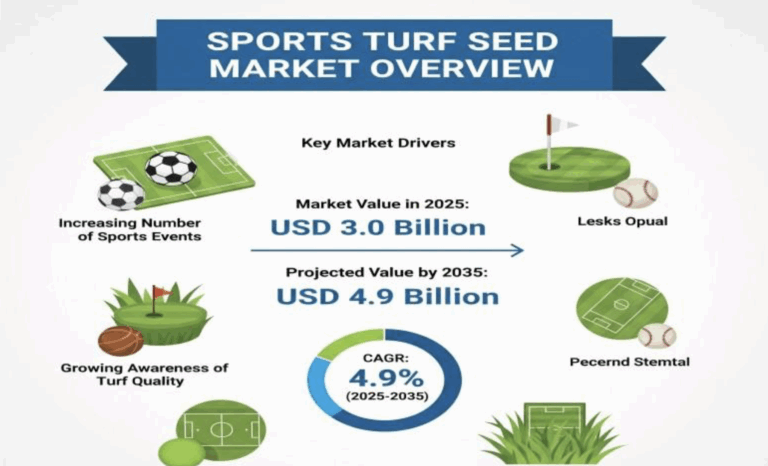
Driven by expanding investment in sports infrastructure and a growing emphasis on high-performance playing surfaces, the global sports turf seed market is projected to rise from $3b today to $4.9b by 2035.
According to the latest Future Market Insights report, the market has already shown steady momentum, climbing from $2.4 billion in 2020 to $2.9 billion in 2024, thanks to increased spending on both professional and community-level facilities worldwide.
By 2030, the market is forecast to hit USD 3.9 billion — nearly 37% of total projected growth. This stage will be defined by rising demand for innovative seed varieties designed to withstand drought, disease, and heavy usage, particularly across football pitches, golf courses, and multi-use stadiums.
From 2031 to 2035, a further 33% growth is anticipated, fuelled by replacement demand, the increasing number of international sporting events, and greater use of sports-grade turf in urban recreational spaces.
Key drivers
Expansion is being propelled by global investment in sports venues, alongside heightened focus on player safety and field quality. Advances in seed genetics are enabling turf varieties that are more resilient and adaptable across climates.
By seed type, Kentucky bluegrass is expected to lead in 2025 with a 29.5% market share, prized for its fine texture and quick recovery under heavy traffic. By application, golf courses are forecast to account for 30% of demand, underscoring the sector’s consistent investment in premium greens and fairways.Although niche compared to the broader seed industry, sports turf seed plays a high-value role. It contributes an estimated 9–11% of the turfgrass seed category and 15–17% within the sports infrastructure segment, compared with just 3–4% of the global seed market dominated by food crops. Its strength lies in performance, resilience, and premium pricing — setting it apart from residential or ornamental turf.
Regional trends
Asia-Pacific is set to lead growth, with China projected to record a 6.6% CAGR between 2025 and 2035, driven by state-backed infrastructure and rising football and golf participation. India follows closely with 6.1% growth, underpinned by new cricket and football venues.
Mature markets in Europe and North America continue to expand steadily, with France and the UK seeing increased demand linked to stadium upgrades and preparations for major tournaments.The sector combines global players and regional specialists. The Scotts Miracle-Gro Company is identified as the market leader, alongside firms such as Ampac Seed Company, DLF-Pickseed / DLF Seeds, and the Barenbrug Group. Competition increasingly centres on breeding programmes focused on wear tolerance, climate adaptability, and disease resistance, supported by partnerships with sports authorities and turf management firms.