



Hilary Aylesworth, chief product & technology officer, PTV Group – part of Umovity – considers how to optimize the complete spectator journey at major events…
***
Every successful event has one thing in common: most visitors never notice the planning behind it. They remember getting to the venue easily, spending little time in queues and leaving safely after the final whistle or encore. What they do not see is the complex operation that begins long before the gates open.
Large sporting events and concerts no longer affect only the venue itself. They place pressure on entire transport networks, public spaces and city centres. Tens of thousands of people arrive within a short time window, often using different modes of transport before converging on the same entrances and security checkpoints. A seemingly small issue—an overcrowded metro platform, an undersized security screening area or a poorly designed pedestrian route—can quickly disrupt the visitor experience and create operational and safety challenges.
Planning these movements safely and efficiently, validating concepts and optimising operations both inside and outside the venue has become a classic application for multimodal simulation.
Looking beyond the stadium
By creating a digital model of how pedestrians, vehicles and public transport interact, planners can explore different scenarios, identify bottlenecks and evaluate operational decisions before the first visitor arrives. Instead of analysing traffic, pedestrian movement or public transport separately, simulation allows planners to understand how every part of the visitor journey influences the next.
The value of this approach is already being demonstrated in practice.
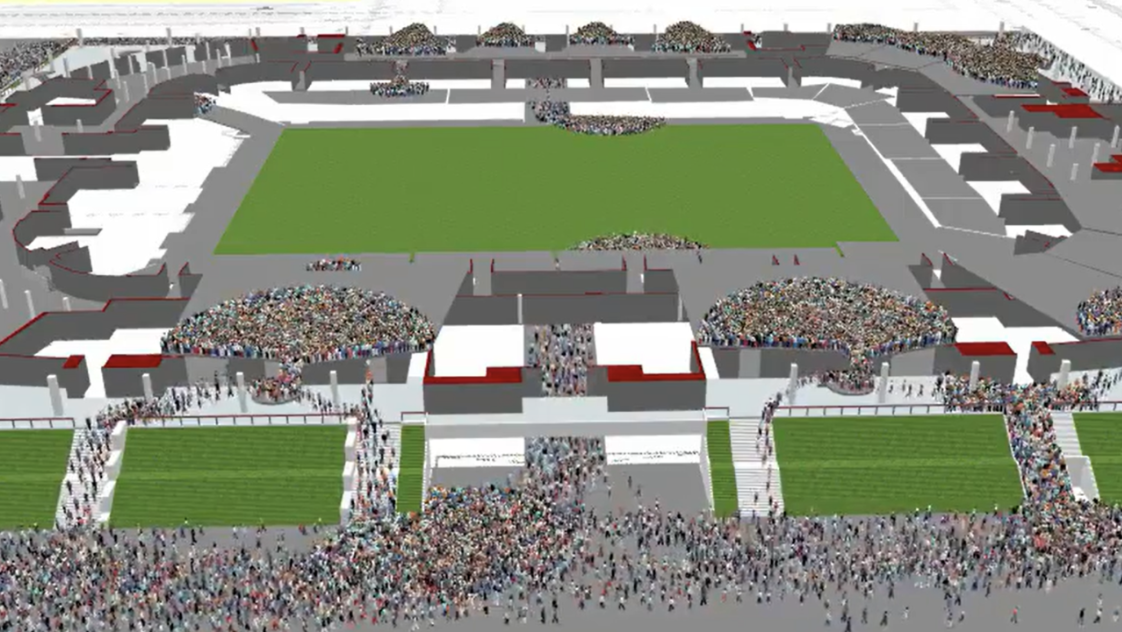
ABOVE: Crowd simulation allows planners to evaluate evacuation strategies, identify risks and refine designs before a venue opens (Visual: PTV Group)
In Stockholm, transport consultants modelled how up to 45,000 visitors would move through a major arena district during large events. The simulation revealed potential congestion around security screening areas and public transport access that would have been difficult to identify through conventional planning alone. As a result, planners recommended additional screening capacity, improvements to pedestrian routes and increased metro services during peak periods.
A similar approach is supporting the proposed new stadium for Oxford United Football Club in the UK. By modelling both pedestrian and vehicle movements on match days, planners were able to assess how visitors could move safely around the site while minimising disruption to surrounding neighbourhoods. Rather than waiting until the stadium is operational to discover problems, potential issues can be addressed during the planning process.
While improving visitor experience is an obvious benefit, simulation also plays an increasingly important role in safety. Major venues must demonstrate that they can be evacuated safely under emergency conditions, but predicting how thousands of people will respond is far from straightforward. Digital crowd modelling allows planners to evaluate evacuation strategies, identify risks and refine designs before a venue opens.
Preparations for the 2014 FIFA World Cup in Brazil highlighted this potential. Simulations carried out for several stadiums identified evacuation routes that required improvement to meet safety standards. At Rio de Janeiro’s Maracanã Stadium, the modelling showed that certain exit ramps would become overloaded during an evacuation. Design modifications, including widening critical routes, improved pedestrian flow and helped the venue meet its safety requirements before the tournament began.
Simulation is no longer solely the domain of transport engineers or specialist consultants. As expectations for safety, sustainability and visitor experience continue to grow, digital mobility solutions are becoming an increasingly important part of the event operator’s toolkit.
And the story doesn’t end with planning. Digital tools can also support event-day traffic management. Real-time traffic monitoring and predictive analytics provide continuous insight into the transport network, enabling public authorities and traffic management centres to anticipate congestion and reduce disruption as visitors arrive and depart.
As the industry continues to evolve, I believe digital mobility solutions will become as fundamental to successful event operations as architectural design or security planning. Whether testing concepts before an event or supporting informed decisions on the day itself, these technologies give cities and organisers something increasingly valuable: the confidence to deliver a safe, efficient and seamless visitor experience from the first journey to the final departure.