

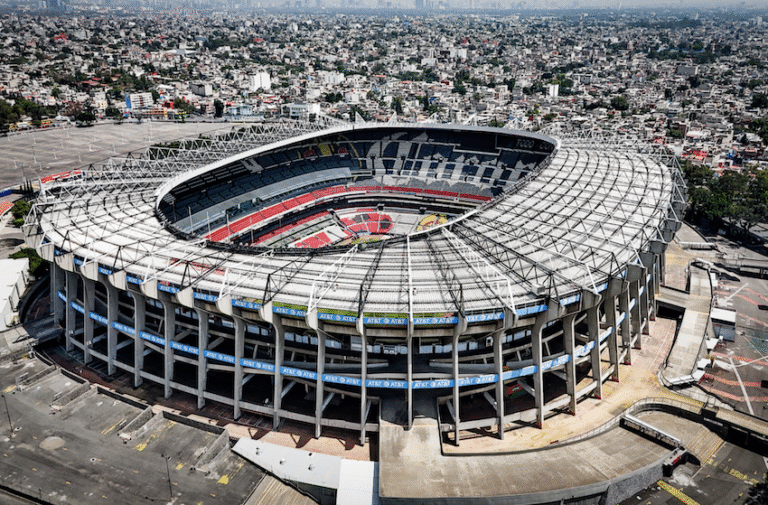
Mexico City’s Estadio Azteca has become the first stadium in history to host three World Cup opening matches. Situated 7,220ft (2,240m) above seal-level, it will host Mexico vs England in the last 16 on Sunday. But the €175m renovation that got it there was late, contested and not without incident…
***
No venue at this World Cup carries more historical weight than the Azteca. The stadium that witnessed Pelé lift the trophy in 1970, Maradona’s Hand of God in 1986 and two World Cup finals needed no introduction. What it needed, ahead of becoming the first ground ever to open three World Cups, was a serious overhaul. What it got was one of the most turbulent stadium renovation programmes in recent memory.
The brief and the build
The renovation was led by Populous – the firm behind some of the world’s most significant stadium projects – working alongside Mexican practice KMD Arquitectos. Their brief was explicit: modernise without erasing. The Azteca’s elliptical bowl, designed in the early 1960s by Pedro Ramírez Vázquez with no internal roof columns and sightlines engineered using advanced isoptic studies, was to be preserved and enhanced rather than demolished. That constraint shaped every decision.
The most visible intervention is a new metal-and-glass roof ring incorporating ETFE panels detailed with hexagonal motifs referencing the iconic Telstar ball from the 1970 tournament. It is engineered to meet Mexico City’s demanding seismic and wind-load requirements and integrates photovoltaic panels. Beyond the roof, the scope was comprehensive: all seating replaced, the façade restored, new LED perimeter and dynamic event lighting installed, and more than 2,000 square metres of LED screens added externally.
Inside, new changing rooms were built beneath the boxes, a dedicated player tunnel created, and press and hospitality zones significantly expanded. The pitch was relaid using GrassMaster hybrid technology, and the venue’s digital infrastructure was rebuilt from scratch – Wi-Fi 6 with 1,000 access points and 40,000 metres of fibre optic cabling. Net capacity rose from around 81,000 to 87,523, confirming the Azteca’s status as Latin America’s largest stadium.
The surrounding infrastructure received equivalent attention. Roughly ten kilometres of roads within Circuito Azteca were repaved, over 30 kilometres of Calzada de Tlalpan upgraded, and the Tren Ligero light rail line modernised, all at a cost of more than 1.4 billion pesos.
Disputed delivery and not without drama
The stadium closed in May 2024 after the Clausura final. A FIFA assessment that April had found it did not meet tournament requirements, pushing the project back by approximately six months. An ambitious re-opening was set for 28 March 2026 — a 0-0 friendly against Portugal — but owner Emilio Azcárraga Jean had publicly acknowledged in February that the venue “will not be 100% ready.” That proved accurate. Journalists reported uneven concrete, unfinished furnishings and chaotic security queues.
A number of premium pitchside seats were withdrawn from sale after advertising boards and photographers were found to block sightlines. More seriously, a spectator died after falling from a suite level during the reopening event. Mexico City’s prosecutor’s office opened an investigation. FIFA formally took control of the stadium on 14 May 2026.
Controversy surrounded the works themselves. In March 2025, the Building and Wood Workers’ International accused FIFA of blocking a planned labour inspection of the site. FIFA’s position — that it did not manage the renovation directly — satisfied few, given that only around seven percent of Mexico’s construction workforce is unionised. Access for inspectors was eventually granted.
Open and operational
On 11 June, the Azteca delivered. Mexico’s 2-0 win over South Africa, in front of an official attendance of 80,824, made it the only stadium ever to have hosted three World Cup opening matches. The atmosphere was, by all accounts, extraordinary.
The ground has now staged four matches – Mexico topping their group unbeaten, conceding nothing – with Tuesday’s round of 16 tie against England the most high-profile test yet, both of the team and of a stadium that had to fight hard to be ready.