

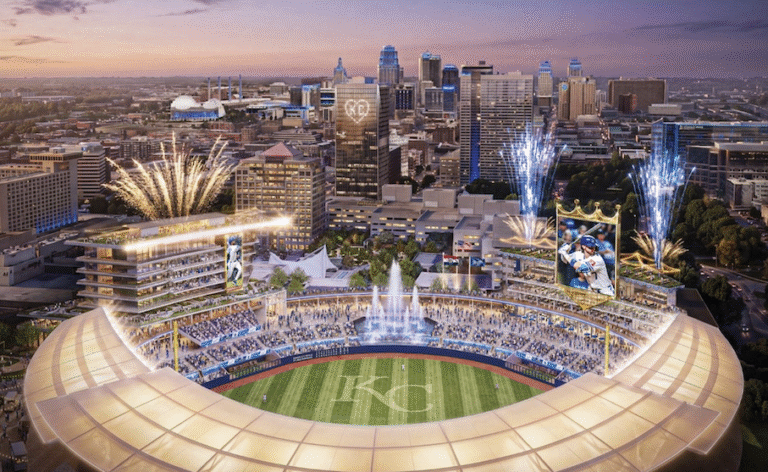
The Kansas City Plan Commission has voted unanimously to rezone the Crown Center area, the first formal step towards an 85-acre ballpark district for the Kansas City Royals, according to KCUR.
The Royals and Hallmark Cards, which owns the Crown Center site, will now move forward with redevelopment plans on that basis. Rezoning is the process by which a local authority changes the designated legal use of a piece of land, determining what can and cannot be built there — in this case, planning officials described it as merely the opening step in a much longer redevelopment process.
The commission’s approval carries two conditions: the Royals must preserve existing parking arrangements for residents of the neighbouring San Francisco Tower, and commission a visual noise-and-light study that will be made publicly available.
The Royals compete in MLB’s American League Central and currently play at the 40,793-seat Kauffman Stadium. Commissioner Matt Hasek argued the new district could help extend the vitality of the northern half of Crown Center into its long under-used southern section, framing the project as an opportunity to build a stadium more tightly woven into the surrounding neighbourhood.
Royals president for real estate and development Brooks Sherman said stadium construction and the wider Crown Center redevelopment, encompassing renovated existing buildings, new commercial space and a large apartment complex, would proceed simultaneously.
Crown Center emerges as the Royals’ preferred site after the club walked away from an Overland Park, Kansas option and let a deadline lapse on a Clay County site north of downtown, across the Missouri River. The club is targeting a 2027 groundbreaking and a 2030 season opening, though its lease at the Truman Sports Complex does not expire until after the 2030 season.
Commissioner Tyler Enders backed the project but called for stronger dialogue between developers and the surrounding community: “I feel as though this project is a huge win for Kansas City, for this area, for this neighborhood, for the community, for the region. The one thing that I really want to see that would make this even easier would be fantastic communication.”
City staff told commissioners the proposal had drawn 63 letters of support against eight in opposition. Objectors argued the process had been rushed and that key questions, particularly around the impact of stadium lighting and noise on residential quality of life, remain unanswered.
San Francisco Tower resident David Byrn, whose building sits inside the rezoned area, said: “Imagine what that means for us living there. And the reality is, yes, you do have to imagine because there’s no photometric study submitted, there’s no lighting plan. If we’re going to build a project of this magnitude, shouldn’t we get it right for our residents and our city?”